 ExamRizzBMAT
BMAT 2017 · Question 22 · Ratio/Proportion/Percentage
SaveA fifth of genomics papers between 2005 and 2015 contained errors in spreadsheets A recent study in the journal Genome Biology looked at papers published in 18 genomics journals between 2005 and 2015, and found spreadsheet-related errors in 20% of articles that provided supplementary data alongside their text. Although the quality of the papers was not necessarily affected, such errors can create complications for other scientists trying to replicate or build on previous work. The charts and the table below summarise the findings. The syntax of genomics makes it particularly difficult for off-the-shelf software to digest. For example, spreadsheets often mistake gene symbols for dates. The authors found that Microsoft Excel would often interpret ‘SEPT2’, which corresponds to the gene Septin 2, as ‘September 2nd’. Such hiccups can be quickly resolved, but they are easy to overlook. The paper’s most worrying finding is that mistakes seem to be proliferating. The authors found that the number of genomics papers packaged with error-ridden spreadsheets increased by 20% a year over the period, far above the 10% annual growth rate in the number of genomics papers published. If we extrapolate current trends indefinitely into the future, soon every spreadsheet attached to a genetics paper will have an error.
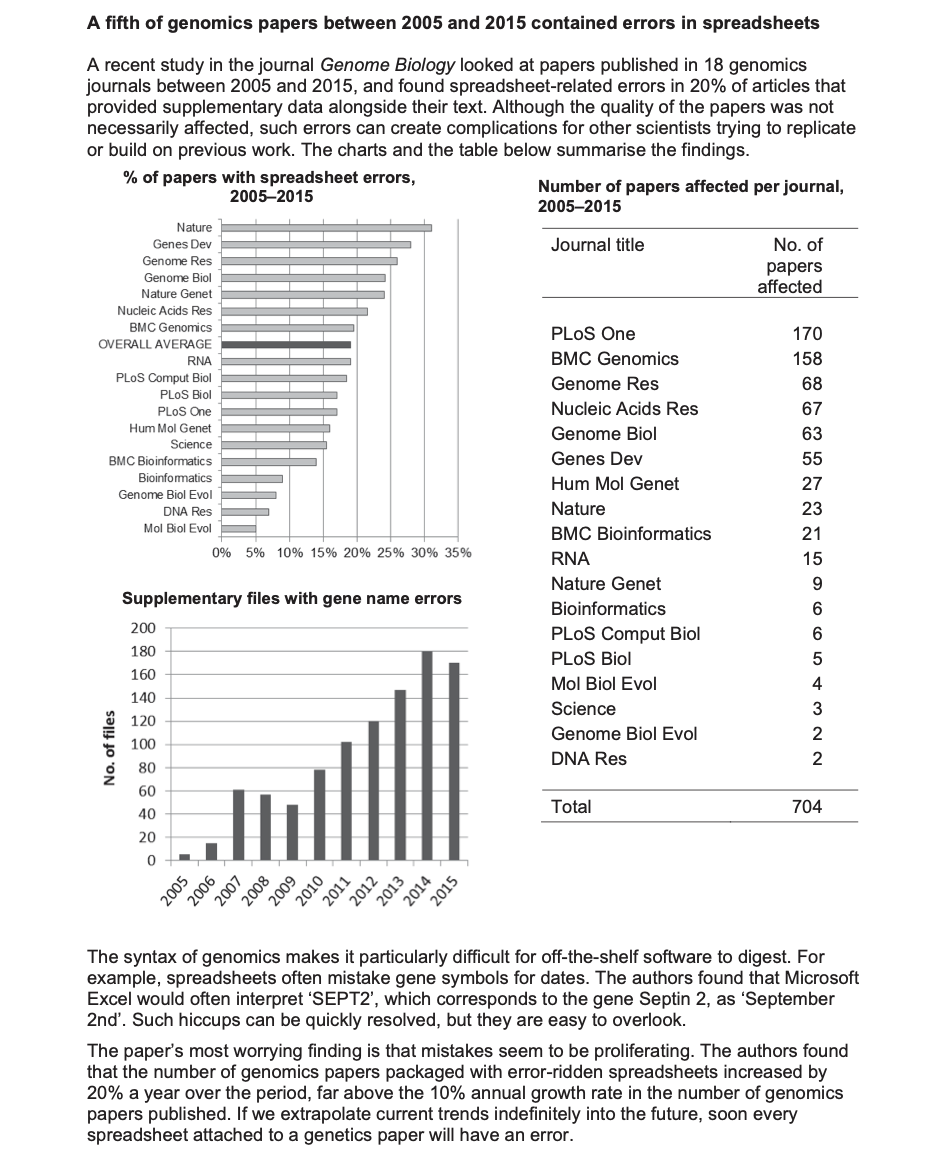
Suppose that 80% of all genomics papers published in 2015 were affected. Using the growth rates expressed in the last paragraph to make predictions about the future, what is the first year in which every genomics paper would be affected?