
BMAT 2018 · Question 22 · Assumption
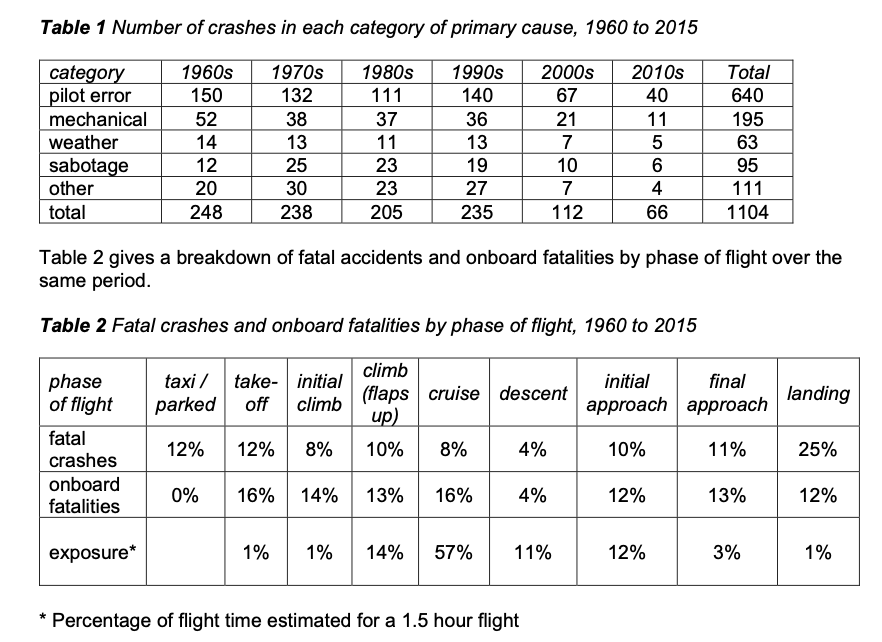
SaveBetween 1 January 1960 and 31 December 2015, there were 1104 fatal passenger aircraft crashes for which a definitive cause was known (see Table 1). The crashes included are those which had ten or more passengers on board and which resulted in at least one fatality. Military and private aircraft and helicopters were excluded. Where there were multiple causes, the most prominent cause was recorded. The category of pilot error includes those crashes in which weather or a mechanical fault was a strong contributing factor to the pilot error. Since 1997, the average number of airliner crashes per year has shown a steady and persistent decline, thanks to the continuing efforts of international aviation organisations and the stringent safety standards now in place in the aviation industry. Recent figures reveal that 2016 was the second safest year on record. There were 17 fatal crashes, resulting in 325 deaths, down from 560 in 2015. Given that a total of around 3.5 billion air passengers flew during 2016, that’s just one death per 10.8 million travellers. Only one year saw fewer deaths – 2013, with 265. But with 3.05 billion passengers boarding a plane that year, that amounts to a very similar number of deaths per passenger (one per 11.5 million). When one discounts sabotage, 2015 was actually the safest year on record. Two crashes, deliberately caused, accounted for the majority of fatalities that year. So it is easy to see that air travel has never been safer.
Which one of the following is assumed by the reasoning in the final paragraph?